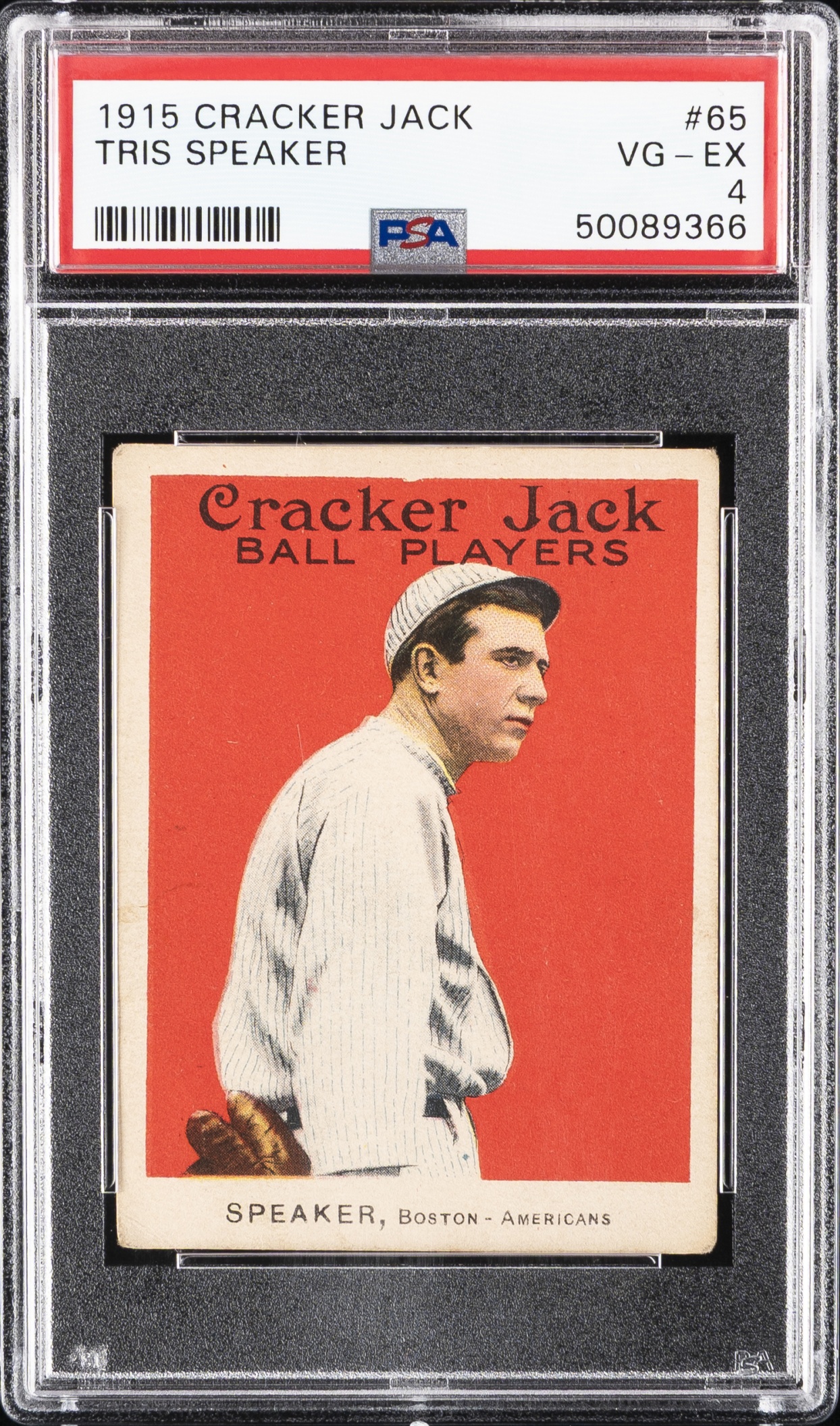
“Buy me some peanuts and Cracker Jack” is part of baseball’s soundtrack. In 1914, Cracker Jack made the connection physical by placing baseball cards directly inside packages of caramel-coated popcorn and peanuts.
The 1914 original
Catalogued as E145-1, the first Cracker Jack baseball issue contained 144 cards measuring approximately 2¼ by 3 inches. Their larger size and brilliant red backgrounds separated them immediately from the smaller tobacco cards collectors knew. The thin stock went straight into the snack package, exposed to sticky caramel and everyday handling. That helps explain why clean 1914 examples are so difficult today—and why PSA considers 1914 the tougher of the two issues.
What changed in 1915
Cracker Jack expanded the checklist to 176 cards in 1915 and gave collectors another route to the set. A complete set could be obtained for 100 coupons, or one coupon plus 25 cents. An album was offered for 50 coupons, or one coupon plus 10 cents. Factory-issued cards avoided direct contact with the candy, which is one reason 1915 examples can be found in stronger condition.
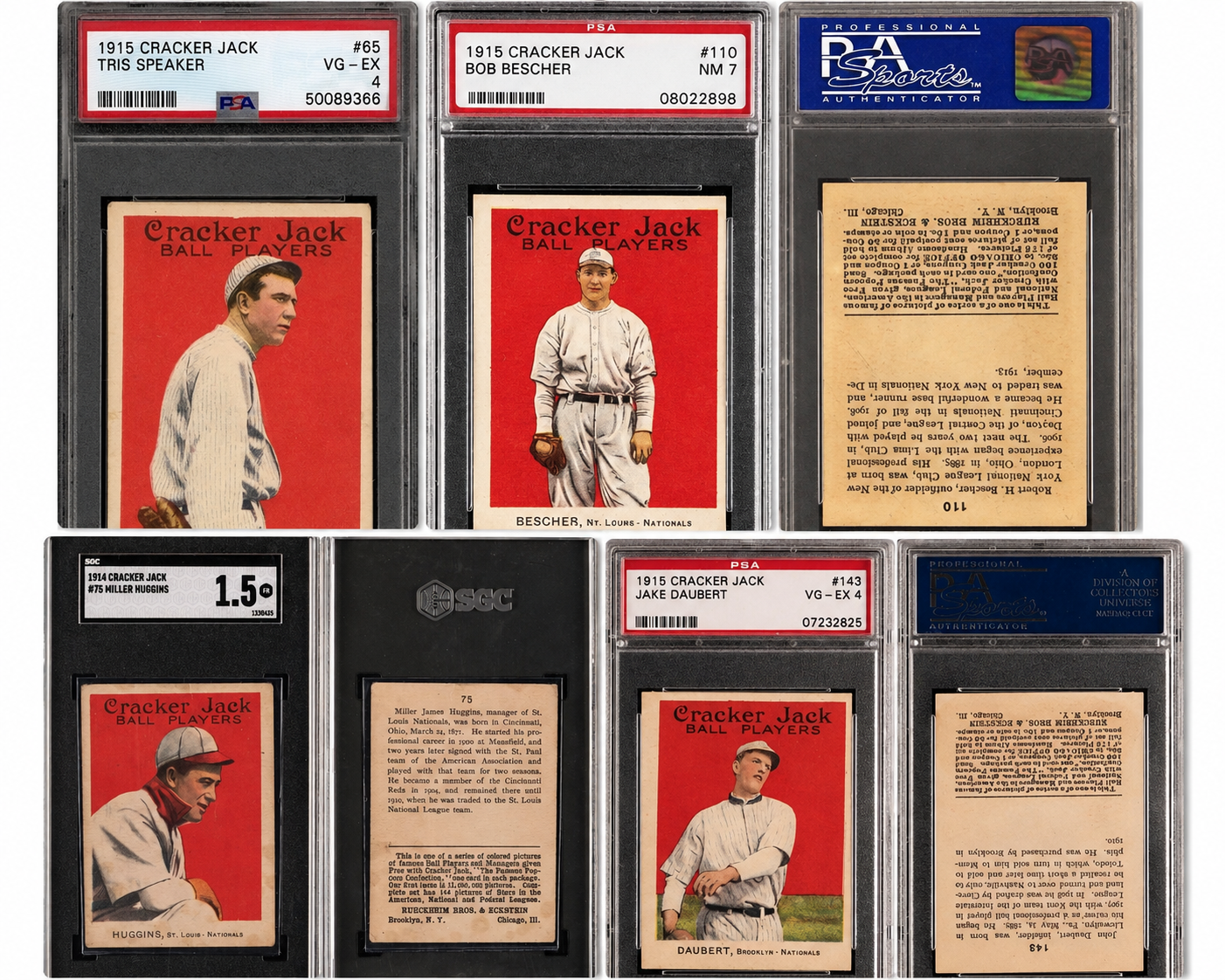
The backs changed, too, including an upside-down orientation compared with the fronts. With an expanded checklist, a mail-away set, and an album to organize it, 1915 felt like a more deliberate collecting program rather than simply a prize hidden in a snack.
Miller Huggins — 1914 #75
The 1914 Miller Huggins #75, graded 1.5, connects the famous manager to the playing career that came first. Huggins was a smart, undersized infielder and player-manager in St. Louis before leading the Yankees to their first six American League pennants and three World Series titles. He entered the Hall of Fame in 1964. Like every 1914 card, this one began life loose inside a Cracker Jack package.
Jake Daubert — 1915 #143
Jake Daubert rose from Pennsylvania coal mines to become one of the National League’s finest first basemen. He won back-to-back batting titles in 1913, when he hit .350, and 1914, when he hit .329. His 1913 season also earned him the Chalmers Award, an early predecessor to the MVP. His 1915 Cracker Jack #143 is graded PSA 4.
Bob Bescher — 1915 #110
Known as “The London Flash,” Bob Bescher led the National League in stolen bases four straight years from 1909 through 1912. His 81 steals in 1911 remain a Cincinnati franchise record. More than a century later, his 1915 Cracker Jack #110 survives in a remarkable PSA 7.
Tris Speaker — 1915 #65
Tris Speaker supplied the star-powered finale. “The Grey Eagle” finished with a .345 career average, 3,514 hits, and a major-league record 792 doubles. He also stole 436 bases, won the 1912 American League MVP, played on three World Series champions, and earned his place in the Hall of Fame. His 1915 Cracker Jack #65 is graded PSA 4.
Two years, one unmistakable red design, and two very different survival stories—that is the magic of Cracker Jack baseball.
Special thanks to @69Camero11080 for suggesting the feature and helping us share these cards and their history.